

The Intermediary Is the Infrastructure
Frontier Capital, Failed Incentives, and the Architecture the Merchants of Julfa Built

Frontier markets have spent decades competing on the wrong variables. The diagnosis is not complicated. The implications are.
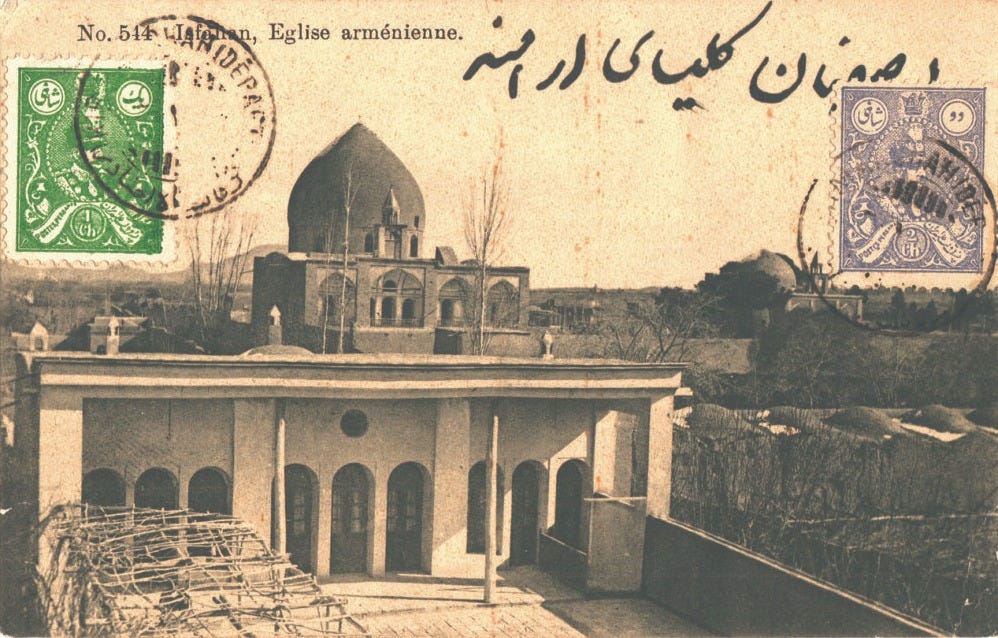
The Scorched Earth Policy: If we lose the territory, you are getting an emptied or scorched version, not a productive one. This was Shah Abbas I’s strategy in Eastern Armenia during the Ottoman-Safavid war in the early 17th century. Fearing defeat, Safavid economic and military strategy was to relocate Armenian merchants, craftsmen and silk traders from their homeland, in contemporary Nakhichevan, Nagorno-Karabakh and Syunik, to the Safavid mainland, notably in Esfahan where Shah Abbas created New Julfa, an Armenian-populated merchant city that became a major Silk Road trading hub. Economic engineering of the most deliberate kind.
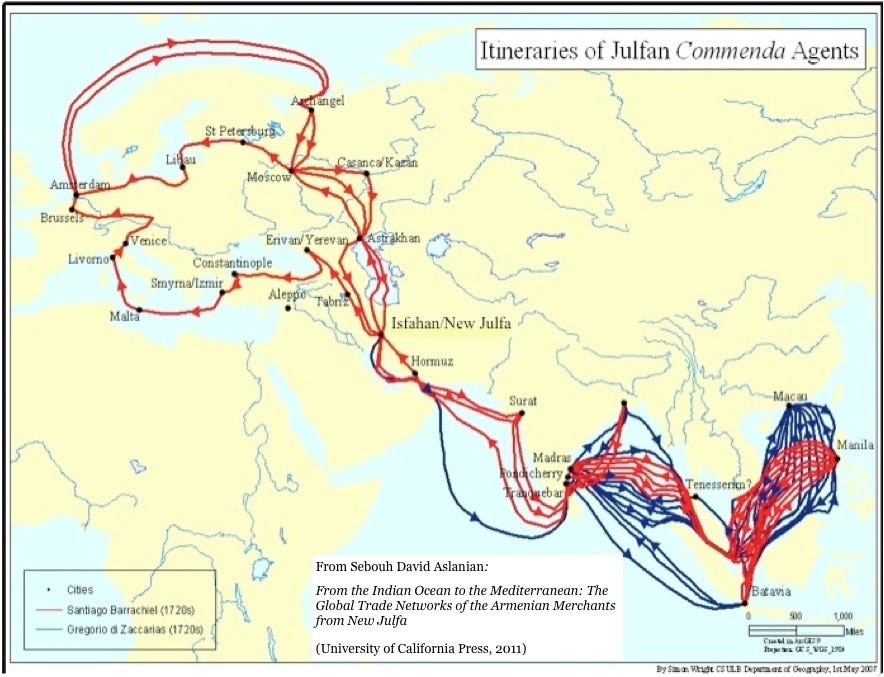
From the original Julfa on the Aras River to the new community in the heart of Persia, one of the most remarkable commercial networks the pre-modern world produced emerged. Julfan Armenians built trading houses stretching from Amsterdam to Cadiz, from Paris to Penang, from Moscow to Madras. Silk, spices, and precious stones were routinely moved across three continents. They operated on trust, a strong network, and on a reputation for reliability that made them welcome in courts that welcomed almost no one else.
They did not succeed because of incentives. No sovereign gave them a tax holiday. No investment promotion agency opened a one-stop shop on their behalf. They succeeded because they held relationships on both sides of every transaction simultaneously - because they were trusted by the buyer and the seller, by the lender and the borrower, by the empire exporting and the empire importing. They were, in the precise sense of the word, intermediaries. And in a world where information was asymmetric, routes were dangerous, and capital moved only where trust had already travelled, the intermediary was the infrastructure.
My grandmother descends from that community, and we, together, have stood in Yerevan and seen a country of extraordinary untapped potential - one that has absorbed more historical trauma per century than almost any nation of its size, and has survived it all, and has still not found a way to convert that survival into the momentum it deserves. The question of why capital has not followed is, for me, inseparable from that larger question.
The answer has nothing to do with incentives.
I. The Misdiagnosis
In September 2022, the heads of 43 African nations gathered in New York on the sidelines of the UN General Assembly for an investment summit. The pitch was familiar: reformed regulatory environments, new bilateral investment treaties, competitive tax structures, and special economic zones anchored by international standards. The brochures were polished. The commitments were announced. The capital did not follow.
This is not an African story. It is a frontier market story, and it repeats itself with remarkable consistency across geographies, decades, and development stages. The governments change. The consultants change. The conference venues change. The misdiagnosis does not.
The misdiagnosis is this: frontier markets believe they are losing capital because their incentive package is insufficiently competitive. So, they improve the package. They cut the corporate tax rate. They build the special economic zone. They hire an investment promotion agency, staff it with returnees from McKinsey and the World Bank, and send delegations to Davos, to FII in Riyadh, and to the London School of Economics. They measure success by MoUs signed and announcements made.
None of it moves the capital that matters.
However, what it does move is a specific and often damaging type of capital: short-cycle, extractive, and opportunistic. Capital that arrives for the arbitrage and leaves the moment it closes. Capital that does not build institutions, does not hire at scale, does not return for a second deal. Kazakhstan built some of the most aggressive SEZ infrastructure in Central Asia across the 2000s and 2010s. The FDI that arrived was overwhelmingly hydrocarbon-linked - capital chasing a resource, not a market. When oil prices fell, significant portions of that capital were restructured or exited. The productive economy - the manufacturing base, the tech sector, the diversified services industry that Vision-style economic planners dream of - remained thin. Mongolia followed a near-identical arc: a mining-driven FDI surge between 2010 and 2012, a series of high-profile foreign investor exits between 2012 and 2014 triggered by regulatory disputes, and a reputational hangover that took the better part of a decade to begin clearing.
Egypt is perhaps the most instructive case because it has run the experiment the most times. Successive governments have liberalised the exchange rate, introduced new incentive frameworks, and launched economic zones along the Suez Canal corridor. Each cycle produces announcements. FDI remains concentrated in hydrocarbons and real estate, asset-linked returns rather than market-linked ones, and the productive economy continues to underperform its demographic potential.
The countries that did attract serious capital through policy reform, Ireland, Estonia, Poland, did so by building institutional credibility over decades, not by announcing it. And even then, the capital that followed was predominantly efficiency-seeking, not ecosystem-building. Institutional reform moves capital. It moves a specific kind of capital, toward a specific kind of return, on a specific kind of timeline. The intermediary moves different capital, toward different returns, faster and earlier. These are not competing explanations. They are different instruments for different objectives.
The incentive is not the problem. The incentive has never been the problem. To be precise: for markets whose priority is ecosystem-building capital rather than efficiency-seeking capital, the misdiagnosis is total.
The problem is that sophisticated, patient capital - the kind that builds a tech ecosystem, anchors a manufacturing cluster, or seeds a hospitality industry - does not move in response to a tax rate. It moves in response to a question that no incentive package can answer: who do I trust here, and who will still be there in year three?
When that question has no answer, the capital finds somewhere else to go. Not because the opportunity is absent. Because the infrastructure to access it is.
That infrastructure is not regulatory. It is not institutional in the formal sense. It is human, relational, and built over time by people who hold credibility on both sides of a capital flow simultaneously.
The question that moves capital has never been answered by a tax rate. Who do I trust here, and who will still be there in year three?
It has always been answered by a person.
II. What Actually Moves Capital
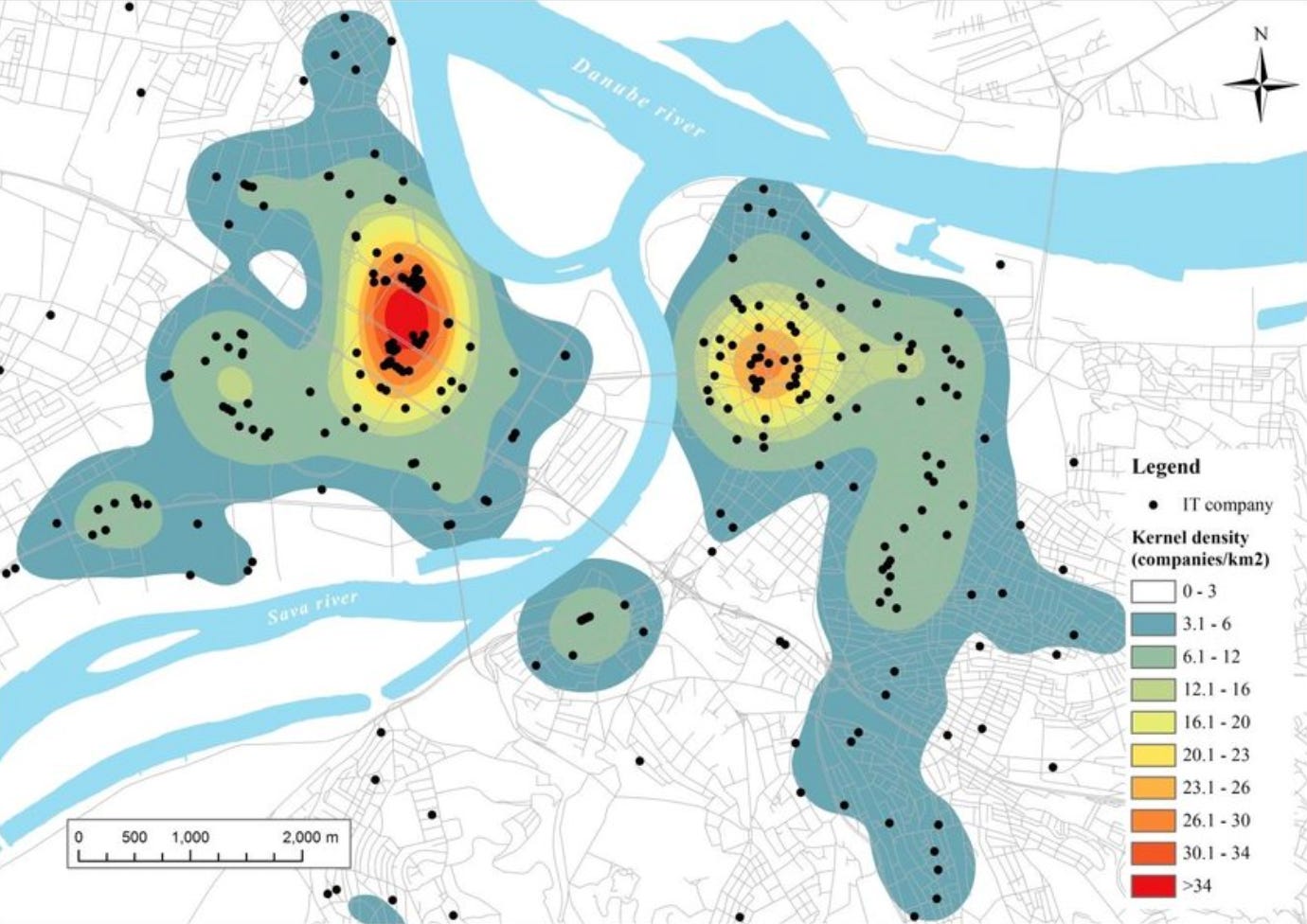
Serbia at the turn of the century was not a country high on many international investor’s shortlist, if there at all. It was emerging from a decade of sanctions, regional conflict, and most pertinent, international isolation that had left its institutions weak, its infrastructure degraded, and its reputation, in the rooms where capital allocation decisions are made, effectively non-existent. It had no credible incentive package to offer. It had no investment promotion agency with a Davos presence. What it had, which might have come across as a negative investment tool, was a large and educated diaspora. Concentrated in Western Europe, engineers, financiers, and entrepreneurs that had left during the 1990s and built careers in Frankfurt, Vienna, Zurich, and London, but who had never fully severed the relational thread back home, became Serbia’s biggest asset.
That thread became the infrastructure.
Not through a government programme. Not through a bilateral investment treaty. Through individual relationships. The mechanism was not one engineer in Zurich - it was a pattern. Serbian engineers, developers, and financiers who had left during the 1990s and built careers in Frankfurt, Vienna, London, and Zurich became, collectively, the connective tissue between a market that international capital could not read and the capital that was looking for somewhere to go. They could vouch for a local partner. They could absorb the informational asymmetry that made Belgrade opaque to an outside investor and translate it into something actionable. They did not do this through a formal structure. They did it through phone calls, introductions, and the slow accumulation of credibility on both sides simultaneously.
The mechanism resists clean documentation. It operates below the level of press releases and investment announcements, in introductions made over dinner and reputations staked on a single phone call. What is documented are the outcomes, and the outcomes are specific enough to be instructive. Microsoft established its presence in Serbia in 2001 and opened its Development Centre in Belgrade in 2005, one of a handful of such centres globally and its first development investment in the region. By 2015, the Belgrade IT sector was generating over €678 million in annual exports. In 2021, Nordeus, a Belgrade-founded gaming studio, was acquired by Take-Two Interactive in a deal valuing the company at $378 million. These are not the outcomes of a competitive tax regime. Serbia’s corporate tax rate is not exceptional. Its regulatory environment is not a model. What it had, at the moment it needed it, was a diaspora network dense enough and trusted enough to compress the informational gap that keeps capital out of markets it cannot read. Talent availability and EU accession proximity mattered too. But those variables were present across the Western Balkans. They were not unique to Serbia. The extensive and culturally cohesive diaspora network was.
This is a different category of decision from the capital that follows a tax rate to Ireland or a labour cost to Vietnam and it produces a different category of return.
Serbia did not design this. It inherited it from necessity. A country that had spent a decade cut off from global capital flows had, in the process, scattered its most capable people across the cities, inside and outside of the former Yugoslav territories, where that capital was managed. When the isolation lifted, those people became the bridge. The lesson is not that Serbia did something right. The lesson is that the bridge existed and that where it existed, capital followed. Most importantly, they took advantage of this opportunity where others do not.
Serbia’s story is not a template. The country remains a complex and unfinished project. EU accession has stalled, political currents have shifted, and the institutional reforms that the diaspora bridge made possible have not always been consolidated. The tech sector that emerged is real, but the broader economic transformation it was supposed to anchor is incomplete. The lesson is narrower and more precise than a success story: when the human infrastructure exists and a country has the self-awareness to recognise it as an asset rather than a symptom of failure, capital can follow through channels that no incentive package could have opened.

The bridge worked. What was built on it is still being decided.
The Serbian case is not isolated. The same mechanism, operating at incomparably greater scale, determined the trajectory of the largest economic transformation of the twentieth century. When Deng Xiaoping opened China’s coastal provinces to foreign capital in 1979, the legal infrastructure was skeletal, the regulatory environment was untested, and the political risk was genuine. No Western institutional investor had a framework for pricing a Communist state’s partial opening. The capital that moved first did not come from London or New York. It came from Hong Kong, Singapore, and Taiwan, from the Hokkien and Teochew merchant communities whose lineage networks traced directly back to the same Fujian and Guangdong coastal villages that the special economic zones were built around. They did not move because the incentives were superior. They moved because they already knew who was on the other side. They had family there. They had done business there across generations. They could read a Fujian handshake in a way that no due diligence report commissioned from a Western firm could replicate. Economists Rauch and Trindade, writing in the Review of Economics and Statistics, quantified the effect precisely: ethnic Chinese networks of the scale present in Southeast Asia increased bilateral trade in differentiated products, the kind that requires trust, matching, and relationship to transact, by a minimum of sixty percent. For intra-Southeast Asian trade, the lower bound was one hundred and fifty percent. These are not marginal effects. They are the difference between a market that opens and one that does not.
The diaspora capital arrived before the institutions matured. It did not wait for a credible legal framework, for WTO accession, or for a functioning commercial court system. It moved because the relational infrastructure already existed, and because the people deploying it could absorb the informational asymmetry that kept everyone else out. The institutions followed the capital. Not the other way around.
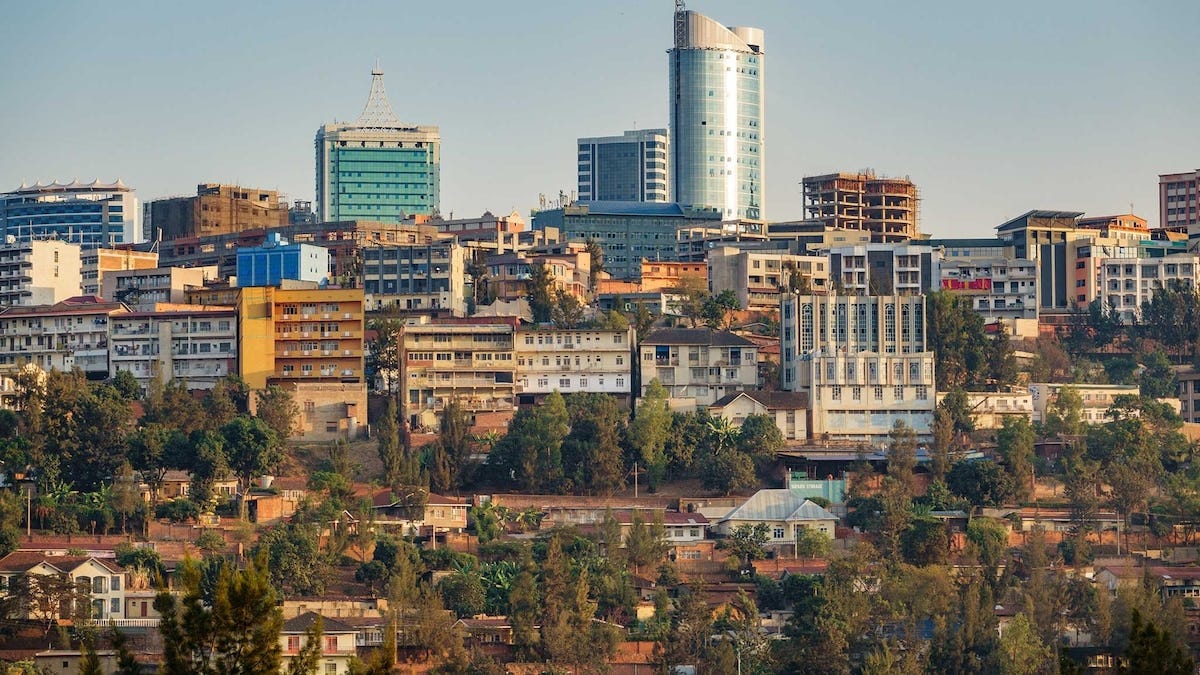
Rwanda offers the mirror image. In the two decades since the genocide, the Rwandan government has built one of the most sophisticated investment promotion apparatuses on the African continent. The Rwanda Development Board operates a genuine one-stop-shop for investors. Kigali has been positioned, with considerable success, as a regional hub. Clean, safe, administratively efficient, ambitious. The narrative is compelling and, in important respects, accurate. Rwanda has attracted attention and announcements in volumes that most frontier markets cannot approach.
But attention and announcements are not capital. The US government’s own investment climate assessment of Rwanda, published through the State Department, documented a specific and damaging pattern: tax incentives and commercial terms negotiated with the Rwanda Development Board were subsequently interpreted differently by the Rwanda Revenue Authority. Investors who had structured their operations around a specific set of commitments found those commitments honoured at entry and contested at scale. The ones who tried to expand, to move from a pilot investment to a substantive operation, encountered a different set of rules than the ones they had been shown at the signing ceremony.
This is the ceremony trap in its precise form. The announcement is optimised. The implementation is not. And the investor who experiences the gap does not return quietly. They tell the next investor. The family office in Jeddah, the emerging markets fund in London, the bulge bracket banks on Wall Street listen - and what makes their ears open is reputational information. That echoes longer than any investment promotion brochure or podcast ever would.
Rwanda is not a failed state. It is not even a failed investment destination. It is a market that has built solid promotional infrastructure around a product that the delivery mechanism has not yet matched.
The gap between those two things is where capital goes to die. Not dramatically, but quietly, through decisions not made, commitments not extended, second investments that never happen.
The Julfan model, however, is not the only model. And the distance between an intermediary that compresses informational asymmetry and one that merely charges rent for access is not always visible until the capital is already inside the market.
The most documented case is Lebanon. For decades, the Lebanese banking sector operated as a closed intermediary network between international capital and the domestic economy. It worked, until it didn’t. By 2019 the system had accumulated liabilities it could not honour, and when it collapsed it did so catastrophically, precisely because the intermediary had become the system rather than serving it. The network that was supposed to compress informational asymmetry had instead made itself the single point of failure. Capital that had moved through Lebanon because of the banking sector’s intermediary function found itself trapped when that function dissolved. The lesson is not that intermediaries are dangerous. The lesson is that an intermediary which makes itself irreplaceable eventually becomes indistinguishable from the risk it was supposed to manage. The Lebanese banking collapse had multiple causes: sovereign debt accumulation, political capture, currency peg maintenance. However, the intermediary architecture accelerated the contagion precisely because capital had no alternative route when the network failed.
A second failure mode is more common and less dramatic. Across West African markets in the 2000s and 2010s, a class of local fixers positioned themselves as essential bridges between Western institutional capital and local opportunity. Some were genuine. Many were not. They charged fees for introductions that went nowhere, represented relationships that were shallower than advertised, and created dependencies that served the intermediary rather than the transaction. The capital that moved through them found itself navigating a network that extracted rent without compressing the informational gap it claimed to bridge. As a documented pattern across the sector, Gulf family offices that deployed into African markets through such intermediaries in that period withdrew within three to five years. Not because the underlying opportunity had closed, but because the intermediary had misrepresented the depth of their access. The opportunity remained. The trust did not.
The West African pattern is documented as observed sector behaviour rather than formally sourced. The transactions that produce these outcomes operate below the level of public disclosure by design. The evidential standard here is lower than the Rauch-Trindade citation and the reader should weight it accordingly. The mechanism, however, is consistent enough across enough cases to be structural rather than anecdotal.
The distinction between a genuine intermediary and a rent-extracting gatekeeper is the most important due diligence question in frontier market investing. It is also the hardest to answer from the outside. The Julfan network solved this problem through a mechanism that no modern compliance framework has replicated: the consequence of misrepresentation was not a fine or a lawsuit. It was permanent exclusion from the only system through which you could operate. That consequence made honesty structurally rational in a way that modern intermediary relationships rarely achieve.
The markets that will attract patient capital in the next decade are not the ones that produce intermediaries. They are the ones that produce intermediaries who cannot afford to lie. The category error of frontier market investment promotion is treating capital attraction as an incentive problem when it is an information problem. Information problems are not solved by tax rates or special economic zones. They are solved by people who hold credibility on both sides of an informational divide simultaneously, who compress the asymmetry that keeps capital out, and who do so at personal reputational cost. That is the intermediary. That is the infrastructure. Everything else is noise.
The deeper point, visible across both cases, is this: capital allocation into opaque markets is not primarily a financial decision. It is an informational and relational one. The investor asking whether to deploy into a frontier market is not, at the critical moment, running a discounted cash flow model. They are asking a simpler and harder question: do I have someone I trust who can tell me what is happening here, and who will still be reachable when something goes wrong?
Incentive packages do not answer that question. Regulatory reforms do not answer that question. A trusted intermediary - a person or institution that holds relationships and credibility on both sides of the transaction simultaneously, that has reputational skin in the game on both ends, and that can compress the informational asymmetry that makes frontier markets genuinely difficult - answers that question.
This is not a new insight. It is, in fact, a very old one, and the people who understood it most precisely were the same community whose story opened this piece.
The Julfan Armenian merchants did not simply trade across three continents. They engineered a financial architecture that most modern institutions would struggle to replicate. At its core was the commenda contract: a merchant in New Julfa would entrust capital to a travelling agent - dispatched perhaps to Surat or Aleppo - who would deploy it across multiple markets and return with the proceeds. The principal bore the financial risk. The agent on the road bore the physical one. There was no collateral. There was no legal enforcement mechanism that could operate across that many jurisdictions, languages, and empires simultaneously. What held the system together was a single variable: reputation.
The consequence of breaking trust was not a lawsuit. It was permanent exclusion from the network. And in a system where the network was the infrastructure, that exclusion was not a penalty. It was extinction. A merchant cut off from the Julfan web could not place his goods in Venice, could not access the trading houses of Livorno, could not move capital anywhere the network had already reached, which, by the 17th century, was most of the known commercial world. That consequence made the system self-enforcing in a way no contract has ever matched.
The infrastructure was human. It was relational. And it worked not because the Julfans had better routes or lower tariffs than their competitors. It worked because every counterpart knew that a Julfan commitment meant something no legal instrument could manufacture.
The market that internalises this today, that stops competing on incentives and starts investing in the human infrastructure that patient capital actually follows, does not yet exist in its complete form. But the conditions for it are present in more places than the consensus currently recognises. One of them is Armenia.
III. Where This Leads
In frontier markets, the gap between what the data shows and what the consensus believes is not a research problem. It is a timing problem. The investors who close that gap first do not do so by being smarter. They do so by being earlier.
The investor who waits for the consensus to form, for the narrative to solidify, for the risk to be priced into a recognisable framework, is not a careful investor. They are a late one.
Armenia in 2022 was not a story that appeared in the allocations committees of Gulf family offices or the emerging market briefs of London-based frontier funds. It was a small, landlocked, post-Soviet republic of three million people, bordered by hostile states, dependent on a security relationship with Russia that was visibly degrading, and governed by a leader, Nikol Pashinyan, whose political trajectory remained, and currently remains, genuinely uncertain and whose handling of the 2020 war in Nagorno-Karabakh had left deep fractures in the country’s institutional confidence.
And yet the numbers told a different story. GDP growth reached 12.6% in 2022, the strongest economic performance in thirty years of independence from the Soviet Union. Foreign-registered companies tripled in the space of eighteen months. A technology ecosystem that had been quietly building for a decade, seeded by diaspora engineers, anchored by a genuinely educated workforce, and operating at a cost structure that made it compelling on purely commercial terms, suddenly found itself absorbing an influx of Russian capital and talent displaced by Western sanctions after the start of the Russo-Ukrainian War. The proof of concept that patient investors had been waiting for arrived not by design but by geopolitical accident. The structural conditions were real. The window was open.
By September 2023 it was forcibly closed.
I should be transparent about my position before making the analytical case. I have no current financial stake in Armenia, but I have a declared interest in its trajectory — one that goes beyond the analytical. That combination does not make me objective. It makes me accountable. The argument that follows should be evaluated on its evidence, not on the authority of the person making it.
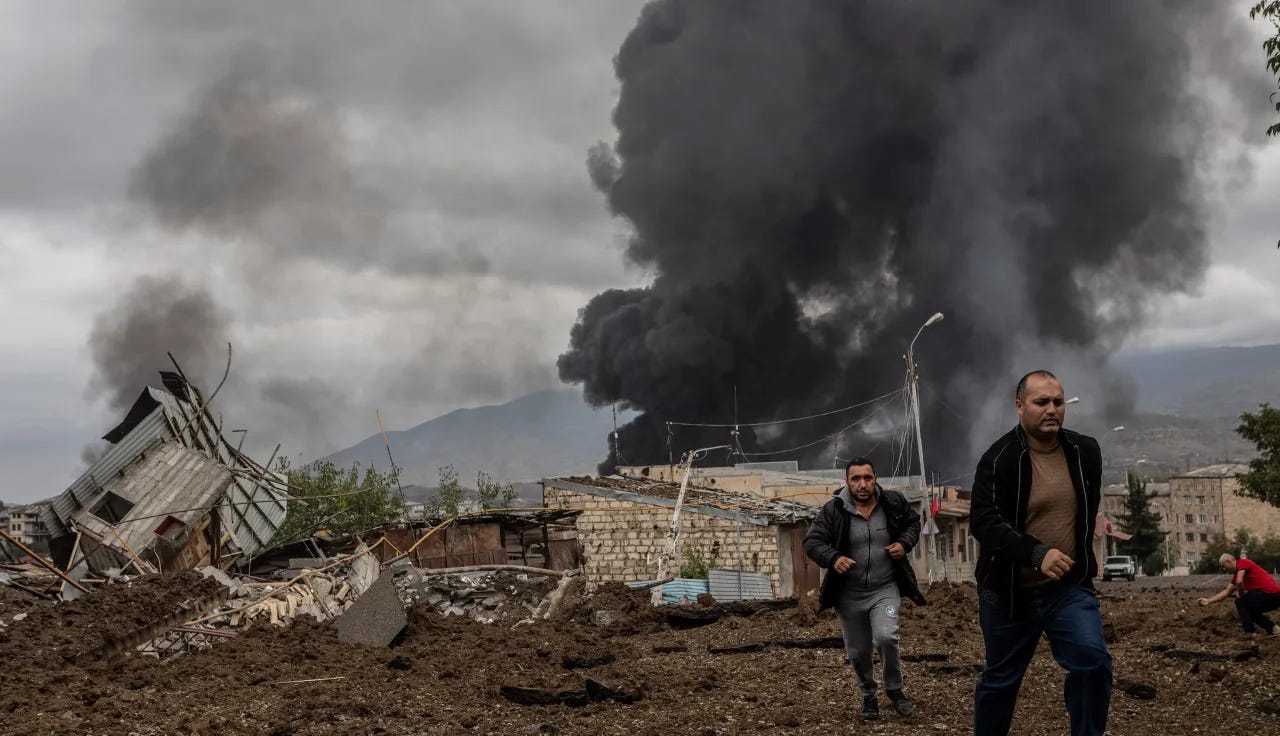
The forced displacement and swift depopulation of the entire Armenian population (over 100,000 people) of Nagorno-Karabakh by Azerbaijan was not an economic event. But its consequences for Armenia’s capital attraction story were immediate and severe. The geopolitical risk premium on the country spiked. The investors who had begun to look away looked away again. The narrative that had briefly, tentatively, begun to form around Armenia as a frontier opportunity collapsed back into the older, more comfortable story: a small country caught between larger powers, too complicated, too exposed, better left alone.
The bearish case on Armenia is not unreasonable. State it plainly: a small landlocked economy of three million people, encircled by hostile or closed borders on three of four sides, politically dependent for three decades on a security relationship with Russia that has now visibly degraded, governed by a leader whose democratic mandate is real but whose strategic competence has been questioned by his own population, facing a 2026 election whose outcome is genuinely uncertain, in a region where the party that just demonstrated its willingness to use military force to resolve territorial disputes has not indicated it is finished. A capital allocator who reads that description and passes is not making an error. They are applying a reasonable prior to an incomplete information set.
The question is whether the prior is correctly calibrated to the specific mechanism that closed the window. It is not.
The 2023 shock was military and external. It was not without instances of poor institutional judgment and strategic miscalculation on Armenia's part - but it was not a deterioration in the underlying economic conditions, or of a reversal in the structural trends that produced 12.6% GDP growth in 2022. The technology sector did not contract because of what happened in Nagorno-Karabakh. The diaspora did not lose its capital or its appetite. The workforce did not become less educated. The cost structure did not change. The EU-adjacent regulatory trajectory did not reverse. What changed was the geopolitical risk premium, a real variable, correctly repriced, but a variable that responds primarily to external configuration, not internal condition.
Sophisticated capital allocation distinguishes between these two things. A market that failed structurally requires a structural recovery. A market that was externally shocked requires a recalibration of the risk premium as the configuration shifts. Those are different investment theses on different timelines. The bearish reader is applying the first framework to a situation that requires the second. That is the misreading. And the investor who corrects it first does not need to be smarter than the consensus. They need to be earlier.
The 2026 election cycle is the most important specific variable in the near-term Armenia thesis and it deserves more than a namecheck. Two scenarios define the range.
In the first, Pashinyan or a successor continues the westward reorientation that has been the defining strategic direction of Armenian foreign policy since 2020: EU association deepening, CSTO disengagement, cautious normalisation with Turkey, increased openness to Western institutional capital. This trajectory does not require Pashinyan personally. It requires institutional momentum strong enough to survive a democratic transition. The question is whether that momentum is structural or personal. The evidence is mixed. The trajectory is possible. The institutions that would carry it are still being built.

In the second, electoral pressure, opposition mobilisation around the trauma of 2023, and the absence of a credible security alternative to Russia produces a reversion toward Moscow. This would not close the structural capital case. The tech sector, the diaspora networks, the workforce remain intact under either scenario. But a Russian reversion would alter and delay the thesis materially, potentially by a decade, by reintroducing the geopolitical alignment risk that Western and Gulf capital cannot seem to price.
The honest answer is that the probability distribution across these two scenarios is not yet legible. What is legible is this: the structural thesis does not depend on Pashinyan. It depends on whether Armenia’s westward momentum has become institutional rather than personal. That is the due diligence question. It is harder to answer than a risk label. It is also the question that determines the timeline.
The capital Armenia needs is not the kind that follows an incentive package - that capital has options and moves on. It is the kind that moves through conviction, relationship, and a reading of structural conditions that the consensus has not yet made. For now, the misreading continues. Most capital that could move into Armenia will not - not because the opportunity has closed but because the framework most investors are using to evaluate it is the wrong one, pricing a permanent condition when what occurred was an external shock. The investors who correct that misreading first will find the diaspora already ahead of them. Armenian capital concentrated in Los Angeles, Paris, Beirut, and increasingly in Gulf cities is not sitting idle. It is looking for the right entry point, the right partner, the right moment of sufficient stability to move with conviction. When it moves, it functions as the proof of concept that institutional capital requires. When diaspora capital moves with conviction, institutional capital has historically followed within a compressible window. That window is where the return is made.
The intermediary, ultimately, captures what the incentive package never could. The person or institution that holds relationships on both sides of this capital flow - trusted by the Gulf family office and by the Yerevan tech founder, that speaks both languages in the precise sense and the cultural one, that was present before the narrative formed and remains present as it does - is not replaceable by a bilateral investment treaty or a reformed tax code. That position, once established, is not replicable by a later entrant. The informational asymmetry does not disappear, it transfers. The intermediary who held it through the uncertain period holds it still when the market becomes legible. The return compounds because the position does.
The question frontier markets face in the next decade is not whether to build intermediary infrastructure. It is whether they can build it honestly. The Lebanon model, where the intermediary became the system, ends in collapse. The West African fixer model, where the intermediary extracted rent without compressing the gap, ends in withdrawal. The Julfan model, where the consequence of dishonesty was extinction, produced four centuries of compounding trust across three continents.
Armenia sits at this junction. The structural conditions are present. The diaspora capital is positioned. The political risk is real and named.
The misreading corrects within five years. The diaspora moves first. The intermediary infrastructure being built now, before the consensus forms, will determine who captures the return when it does. I am willing to be measured against that, providing the right intermediaries emerge.
The merchants of Julfa did not build the infrastructure after the routes were proven safe. They built it first, and the capital moved because they had.
That is not a historical footnote.